
For the Persians I will Weep
Commemorating Ferdowsi/Persian Language Day 2023

It’s ironic that Iran, once known as Persia, is currently the most hardcore Islamic theocracy on the planet. Because, in some respects, Islam never completely took hold there.
After the death of Muhammad, Muslim warriors burst out of the Arabian peninsula and proceeded to spread their religion on the nations they conquered. In 636, they defeated Persian forces at the Battle of Qadisiyyah in southern Iraq. The conflict marked the end of the Sasanian Dynasty and the beginnings of Islam in Persia.
At Qadisiyyah, the Muslims overthrew a civilization much older than their own, with a proud history going back over a thousand years, to the religious thought of Zoroaster and the Achaemenid Empire of Cyrus the Great. Even today, some Iranians look down on the foreign, Arab culture that was imposed on them.
Many Muslims view the years before Islam as the Jahiliyyah—the Time of Ignorance—whose relics must be wiped off the face of the earth. In recent years, the world has watched in horror as the Taliban blew up the 6th century monumental Buddha statues in Bamyan, Afghanistan and ISIS destroyed irreplaceable Roman ruins in Palmyra, Syria. There is even talk in some jihadist circles of demolishing the Pyramids.
But in Iran, even under the fanatical Islamic Republic, the ancient Persian heritage lives and breathes. Pre-Islamic monuments are treasured and preserved as tourist destinations. The faravahar—the Zoroastrian symbol of a guardian spirit riding a winged throne—may be seen etched in stone all over the country—despite being graven images, forbidden in Islam. They may be found from the colossal bas-relief of Darius I at Bisotun in the west of the country, carved around 500 BC, to an Achaemenid-inspired tomb in Tus in the east, built in 1934.
The use of ancient Persian design motifs in this particular tomb is especially fitting. No name is more closely associated with the revival of Persian nationalism and language in the wake of the Islamic conquest than that of the man buried there: Abu’l-Qasem Ferdowsi. Which is why today, May 15, Iranians commemorate Ferdowsi/Persian Language Day. As we’ll see, the two go hand-in-hand.1
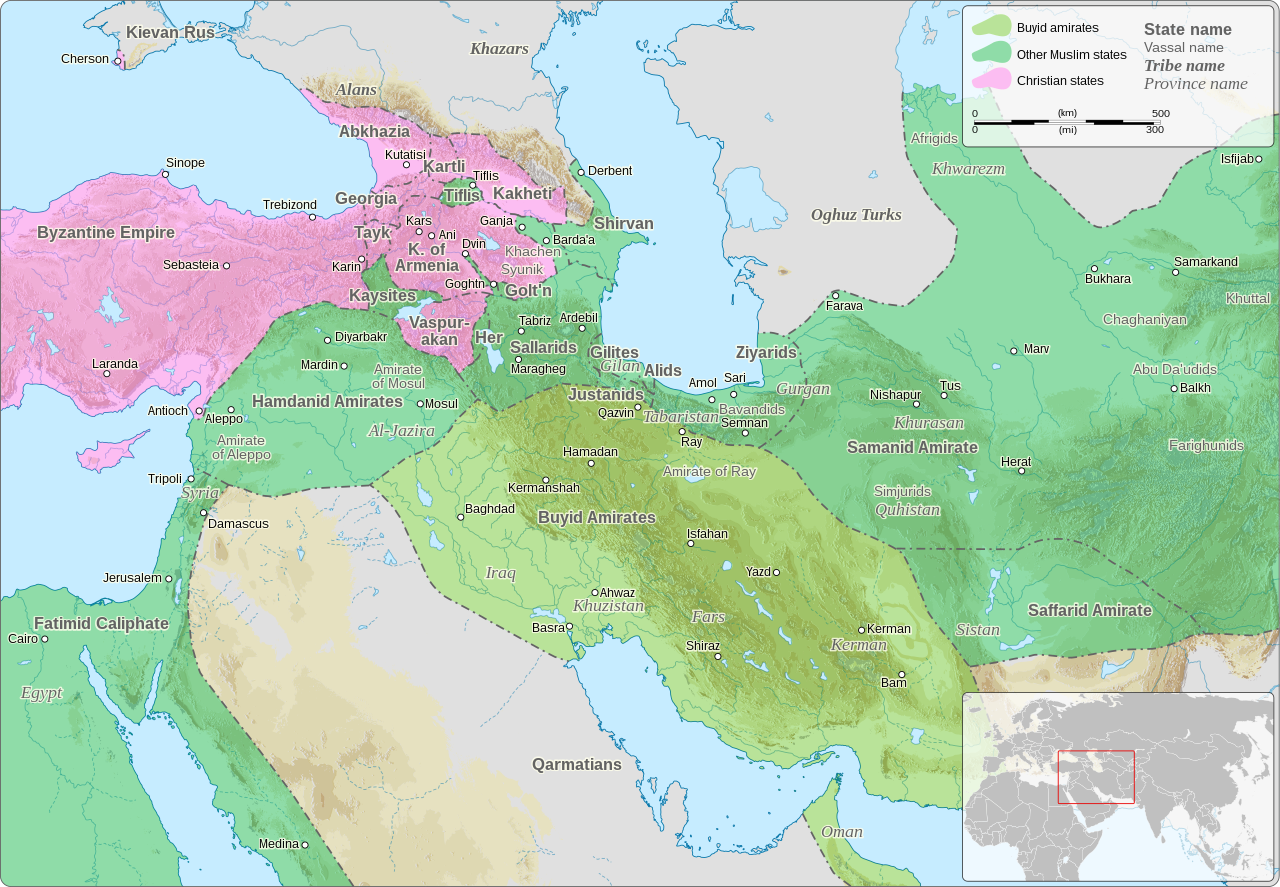
Ferdowsi was born in Tus in the year 940. His lifetime coincided with an era of great instability in Persia. For hundreds of years, the area had been under the heel of the Arab caliph in Damascus, and then Baghdad. Arabic was the language of culture and scholarship. Much like the Iranian demonstrators of today, who have taken to the streets to protest against the hijab and the morality police, and for “Woman, life, freedom,” the Persians of the Middle Ages chafed under the yoke of the Shari’ah.
But by the 900s, the caliphate was losing its grip on the Muslim world. Persia broke up into a dozen smaller and often-warring kingdoms which gave lip service to the caliph, but were actually ruled by dynasties of native origin: Tahirids, Saffarids, and Sajids, Samanids, Ziyarids, and Buyids, Sallarids, Rawadids, Marwanids, Shaddadids, Kakuyids, and Annazids.
With great instability comes great opportunity. The petty despots who ruled these kingdoms fancied themselves patrons of the arts and sciences. Thus, there were numerous courts that an aspiring poet or philosopher could choose from to seek patronage. The era was called the Iranian Intermezzo, an ideal incubator for a rebirth of Persian language and culture. Ferdowsi, descended from the landowning aristocrats of the Sasanian period, was the ideal man to lead it.
In the late 970s, Ferdowsi began writing the Shah-Nama or Book of Kings, his magnum opus. Emphasis on the word magnum. It is the longest epic poem by a single author in history. At 50,000 lines (depending on the edition), it surpasses the Iliad by a factor of more than three.2 It does nothing less than tell the entire history of Persia, from "the first man to seek the crown of world sovereignty," to the last Sasanian emperor, murdered after the defeat at Qadisiyyah.
The early chapters are largely myth. We meet the legendary figures of Jahiliyyah Persia. And despite being non-Muslim, they’re portrayed as heroes. Among them is King Jamshid, a Promethean figure who blessed humankind with metalworking, textiles, bricklaying, mining, perfume, medicine, shipbuilding, and (on the downside) the caste system, before flying off on a gem-encrusted throne on the first New Year’s Day. He is eventually overthrown by Zahhak—a demon-king with a snake growing out of each shoulder. Every day he had two men killed in order to feed their brains to the serpents.
Okay, Zahhak is most definitely not a hero. But one of his descendants is the greatest hero of all: Rostam. Interesting that they’re related. Evidently Ferdowsi shared the notion found in the Star Trek episode “The Enemy Within” that to be effective in the service of good, a hero needs just a little bit of evil in the mix. Like Caesar, Rostam is born by Caesarian section. Like Hercules, he must complete a series of heroic labors, seven in his case, which include resisting a sexy sorceress and slaying a dragon. Rostam serves many kings, most notably Kay Kavus. A stupid and unworthy master, Kay Kavus is constantly getting himself in trouble, from which Rostam must extricate him.
Rostam’s story is often tragic. Due to the machinations of wicked kings, or even simple misunderstandings, he frequently finds himself in conflict with opponents who are quite sympathetic. Indeed, unbeknownst to him until it’s too late, he kills his own son at the climax of an epic battle.
But the Shah-Nama is much more than a collection of heroic tales. It is a window into Ferdowsi’s own times. Through it we see the rituals of daily life, from the protocols of the royal court to the methods of laundering clothes. We learn the colors worn by those in mourning and the instruments used by astrologers. We learn the popular idioms. A handsome man is “tall as a cypress” with a “face like a full moon.” A young person “still has the smell of mother’s milk on his lips.” And we learn the attitudes. Ferdowsi’s worldview is fatalistic; every attempt to evade the prophecies of the astrologers fails. It’s an extremely class conscious society, where a commoner masquerading as a king will soon be found out, as will a king masquerading as a commoner. But it’s also a society where loyalty, friendship, bravery, and wisdom are greatly valued.
As the book progresses, it leaves legend and myth behind and enters the era of recorded history. In the later chapters, we get a fairly accurate rendering of the reigns of the Sasanian shahs, and finally the Battle of Qadisiyyah and its aftermath.
In this last episode, not only does Ferdowsi continue to depict pre-Muslim figures as heroes. He also, with great skill, depicts the Muslim conquest as a heartrending tragedy. Shah Yazdegerd III appoints a commander to lead the Persian forces against the Arabs. Through some cosmic accident, the commander has the same name as his nation’s greatest hero: Rostam. Yazdegerd and Rostam behave with nobility throughout. Alas, no man can escape destiny—there’s that fatalism again—and the Persians are destined to lose. Rostam and the Arab commander, Sa’d ibn Vaqas face off in single combat. It seems that Rostam has the advantage but then, hidden by the dust of the battlefield, Sa’d is able to thrust his sword through Rostam’s helmet and kill him. Yazdegerd flees east to Khorasan in order to raise a new army to fight the invaders. But there is an air of hopelessness over the endeavor. As he takes leave of his court, “everyone turned away, filled with grief and anguish, weeping and lamenting.” They knew they would never see their king again.
Yazdegerd takes refuge with Mahuy, the Governor of Marv, a man of humble origins who Yazdegerd had raised to his exalted position. But Mahuy, coveting the throne for himself, betrays his benefactor. He incites the Turks to attack. The shah leads Mahuy’s troops out to face them. “But when the king attacked the Turks, none of his warriors followed him; they all turned their backs on their monarch and abandoned him to the enemy cavalry...The king fought furiously, striking out with his sword, urging his horse on with his stirrups, and killing many of the enemy’s renowned warriors.” Realizing his position is hopeless, Yazdegerd escapes the battlefield and hides out in a mill. The miller finds him there and reports him to the governor, who orders him to kill the shah. The ultimate ignominy in that class-conscious society—for a king who fought so nobly to be murdered by a person of such low rank.
On the eve of Qadisiyyah, Rostam consulted with his astrologers and knew what was to come. He does not mourn for himself. He mourns for his country. It is a beautiful and moving passage. I regret I only have space here for a short excerpt. I encourage you to read it in its entirety in the excellent translation by Dick Davis.3
I see what has to be, and choose the way
Of silence since there is no more to say:
But for the Persians I will weep, and for
The House of Sasan ruined by this war:
Alas for the great crown and throne, for all
The royal splendor destined now to fall,
To be fragmented by the Arabs' might;
The stars decree for us defeat and flight.
Four hundred years will pass in which our name
Will be forgotten and devoid of fame...

Then Persians, Turks, and Arabs, side by side
Will live together, mingled far and wide—
The three will blur, as if they were the same;
Their languages will be a trivial game.
It is, of course, Ferdowsi himself who is mourning here, mourning the murder of his language and culture at the hands of the invaders, and the assimilation of the Persian people into the greater Muslim world. His prediction that “Four hundred years will pass in which our name will be forgotten” is remarkably on the nose. Ferdowsi completed the Shah-Nama in 1010 AD—the year 400 in the Muslim Hijri calendar. So four hundred years really did elapse before the names of the Persian heroes of old would be remembered again—thanks to Ferdowsi.
It is impossible to overstate the influence of the Shah-Nama. Like the works of Homer and Virgil, it relates The National Epic—the story of how the nation became the nation. It stirs the hearts of patriots. Just as Dante’s Divine Comedy cast aside Latin—the language of scholars—in favor of the Italian spoken by the people, the Shah-Nama cast aside Arabic in favor of the vernacular Persian, and therefore, like the Divine Comedy, stands at the starting point of the national literature. Ferdowsi prevented the Persian tongue from becoming so corrupted with Arabic as to be unrecognizable. For that he is called “The Father of Modern Persian.”
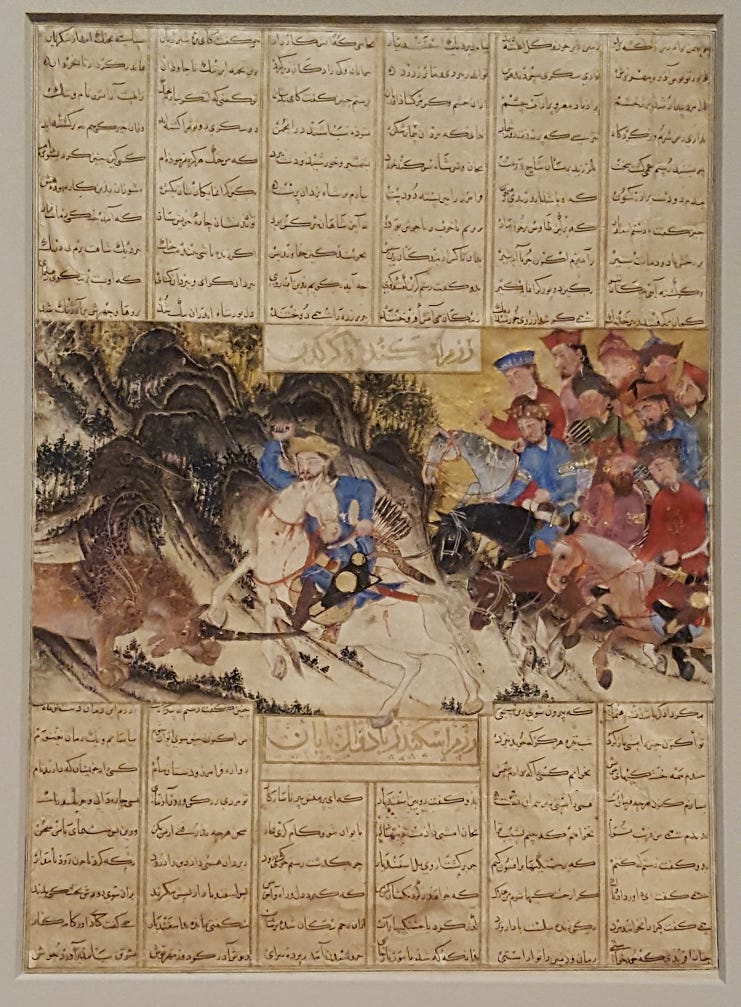
The Shah-Nama inspired generations of artists to create beautiful illuminated manuscripts with stunning calligraphy and colorfully illustrated scenes from the stories. Poets filled their verses with references to its characters and events. The Rubiayat of Omar Khayyam, for example, alludes to Jamshid, Rostam, and many other kings and heroes of the Shah-Nama.
And the book literally taught rulers how to govern. A popular form of literature in medieval Islam was the so-called “mirror for kings.” Like Machiavelli’s The Prince, this was a manual of advice for rulers about how to administer their realms. Ferdowsi’s influence on these works is palpable. Two of the most famous mirrors were written by men who, like Ferdowsi, were natives of Tus: the powerful vizier Nizam al-Mulk (d. 1092) and the eminent scholar of Shari’ah Abu Hamid Ghazali. The discussion in the Nizam’s Book of Politics of the proper relationship between a sultan and his vizier is straight out of the Shah-Nama. And Ghazali’s Counsel for Kings contains numerous examples drawn from the career of Shah Anushirvan, one of the heroes of the Shah-Nama, known to the history books as Khosrow I. That the pious and bigoted Ghazali would hold up the unbeliever Anushirvan as a model to be emulated is an astounding testament to the esteem in which Ferdowsi was held.
Ferdowsi concludes the Shah-Nama with a brief epilogue:
I've reached the end of this great history
And all the land will fill with talk of me:
I shall not die, these seeds I've sown will save
My name and reputation from the grave,
And men of sense and wisdom shall proclaim,
When I have gone, my praises and my fame.
What these lines lack in humility they make up for in truth.
Upon completing the Shah-Nama, Ferdowsi presented it to the most powerful sultan in the region, Mahmud of Ghazna, in the hopes of being rewarded for it. Whether he succeeded is the subject of my next post: How Ferdowsi Tried to Get Paid for the Shah-Nama (Premium Content—Paid Subscribers Only)
Michael Isenberg likes ribeyes, bourbon, and writing historical novels set in the medieval Muslim world. Please check out his latest, The Thread of Reason, at http://amazon.com/dp/0985329750.
I have been unable to find out why the date May 15 was chosen for Ferdowsi Day. It doesn’t seem to correspond to anything in his life. If anyone knows, please leave a comment.
The longest epic poem by multiple authors is the Mahābhārata, with over 200,000 lines.
Ferdowsi, Abolqasem, Shahnameh: The Persian Book of Kings, New York: Penguin Books (1997-2006), Dick Davis, tr.
Yet another edifying and meticulously prepared article by Michael. Drawing me in, this piece made me itch to look up more examples of Persian art and cultural practices, and to read this epic poem in its entirety one day. The fragility of just about everything, and the beauty that deserves to persevere, is brought to light by writings such as this one. Thank you, Michael, for another excellent read.